MODULE 05 — CONTINUOUS INTELLIGENCE
Insights from the patterns your team doesn't have time to find.
An agent that watches your operations around the clock and answers in plain language. It cuts the alarm noise, catches the slow drifts before they break, and surfaces the handful of things that need an operator's judgment.
Your operators are buried in data they can't act on.
SCADA systems collect thousands of data points every minute. Traditional dashboards display the data. But the bottleneck was never access. It is attention. Walk into any control room and you will find dozens of acknowledged alarms that nobody investigates. The data is there. The patterns are there. Nobody has time to read what SCADA is trying to tell them.
Hundreds of alarms a day, most of them noise.
Most are nuisance alerts from a control system that was never properly tuned. A process train goes offline and the alarms still fire. Operators dismiss irrelevant alerts time after time. No wonder the one that actually matters gets missed.
Trends hide in plain sight.
A pump drawing slightly more current each week. A chemical feed rate drifting upward. A valve cycling more frequently. Each change is too small to notice in a single shift. The trend tells a story nobody has time to read.
The $500K fix that doesn't exist yet.
The SCADA integrator quoted $200,000 for a custom dashboard. The digital twin vendor proposed $500,000 and a 14-month timeline. The AI startup couldn't explain their data handling. All options require IT support that most utilities don't have.
Connect to SCADA and operational data
The AI agent connects to your existing SCADA, historian, and operational data sources. Read-only access. No control system changes.
AI analyzes alarm patterns and process trends
Continuous monitoring of alarm frequency, equipment behavior, process trends, and cross-system interactions. The AI learns what is normal for your specific operation.
Operators ask questions in plain language
Instead of building reports, operators ask: "What is different about pump 3 this week?" or "Show me chlorine trends for the last month." The AI responds with data and context.
AI surfaces insights, operators decide action
The AI identifies patterns and recommends investigation. Operators decide whether and how to act. The system never controls equipment or takes autonomous action.
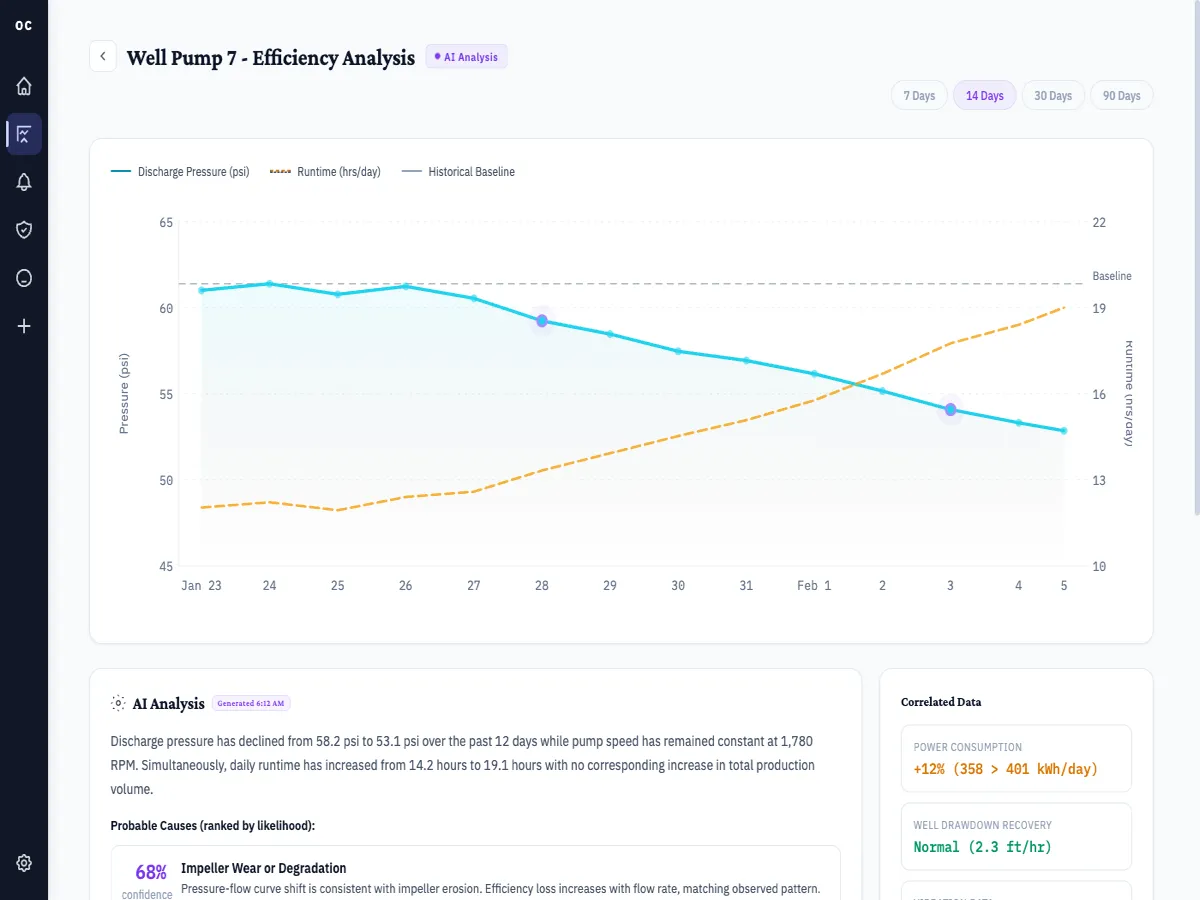
FIG. 05 — AI OPERATIONS CO-AGENT
What's in the module.
Alarm rationalization
It learns which alarms your operators act on and which they wave off, then quiets the noise and flags the gaps.
Process optimization
Catches the slow drifts: a creeping current draw, an energy pattern, a chemical feed that could run leaner.
Equipment degradation detection
Spots the early signs of bearing wear, a failing seal, or performance slipping, before they break.
Natural language queries
Ask about your operations in plain language. No report builders, no query syntax.
Read-only safety model
It observes and recommends. It never touches your equipment or acts on its own.
Custom agent builder
Build agents for your own operation, or start from templates for the common ones.
One prevented failure pays for the year.
The AI Co-Agent doesn't replace operators. It watches what they don't have time to watch. When it finds something worth investigating, it surfaces the pattern in plain language and puts it in front of the operator who needs to see it. The operator decides what to do. No $500,000 implementation. No 14-month timeline. The agent connects to your existing SCADA historian in read-only mode and starts working.
$50K+
Average cost of a single preventable equipment failure
40-60%
Alarm noise reduction through rationalization
$80K
Annual module cost
One prevented equipment failure ($50K+) covers the annual cost. Alarm rationalization reduces noise by 40-60%, so your operators investigate the alarms that matter because the agent already filtered the noise.
- ISA-18.2, Management of Alarm Systems for the Process Industries: Nuisance alarm rates exceed 50% at typical industrial facilities.
- AWWA, 2024 State of the Water Industry Report: Workforce shortages ranked among the top 10 industry concerns.
- Industry benchmarks: Digital twin implementation costs for water utilities commonly range $250K-$1M+ with 12-24 month timelines.
Start where it hurts most. Deploy one module or run them as one platform.
Request a demo